

Drywall Repair vs. Replacement in Minnesota Homes: How Pros Decide After Water Damage and Settling Cracks
A brown ring on the ceiling or a hairline crack running from a doorway corner rarely means the whole wall needs to come out - but sometimes it does. The difference between a $300 patch and a $1,500 rebuild comes down to a professional assessment of the substrate. Here is how we decide between repair and replacement on Twin Cities drywall, and why a small stain can occasionally signal a larger scope.
First question: is it a cosmetic defect or a moisture event?
Most drywall problems fall into one of two buckets.
Cosmetic defects - nail pops, tape failure at seams, stress cracks at door and window corners, and dented corner bead - are surface issues. The board itself is sound. These are almost always a repair, not a replacement.
Moisture events - roof leaks, plumbing failures, and ice-dam intrusion - are different. Gypsum board loses structural integrity when it gets wet, and trapped moisture invites mold. Here, the decision hinges on how far the water traveled and whether the board is still solid.
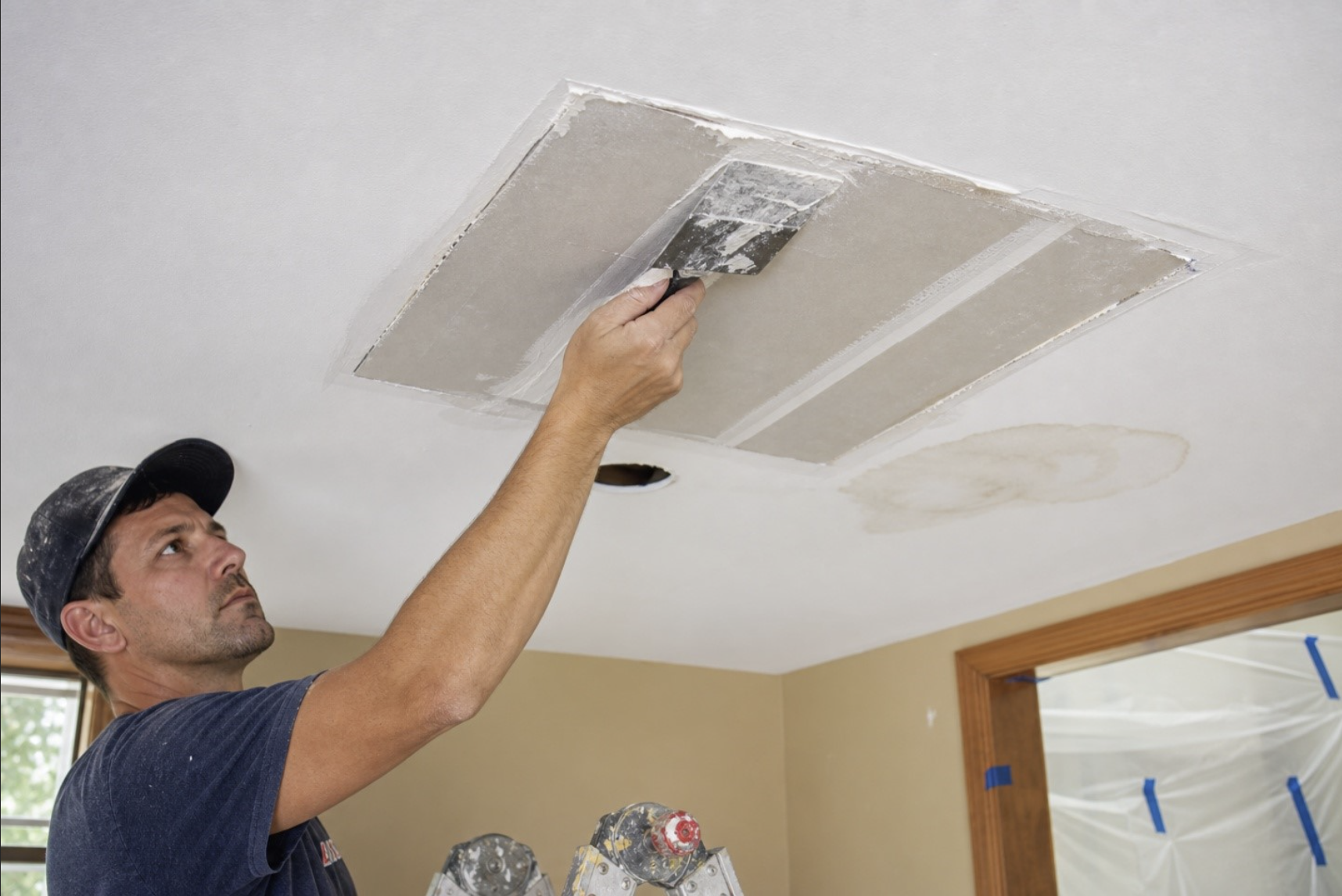
When a repair (skim coat or patch) is the right call
We repair rather than replace when the board is dry, firm, and dimensionally stable. Typical repair scenarios:
Nail pops and small dings: refasten to the framing, then skim.
Tape failure on flat seams or at vaulted-ceiling transitions: re-tape and re-finish rather than replacing sound board - a common defect in Minnesota housing where seasonal framing movement stresses long ceiling runs.
Stress cracks at openings: these recur from framing movement, so we correct the underlying joint, not just the surface, to keep the crack from telegraphing back through fresh paint.
Small, fully dried water stains where the board remains firm: seal the stain with a stain-blocking primer, skim, and repaint.
Standard patch-and-finish repairs across Minneapolis and St. Paul run $150–$500.
When replacement is the only defensible option
We cut out and replace board when integrity is compromised:
The board is soft, sagging, or crumbling - wet gypsum will not hold fasteners or finish.
Moisture readings remain elevated behind the surface, indicating the source is active or the cavity is still wet.
Mold is present on the paper facing or in the cavity.
The damaged area is large enough that patching would create more visible seams than a clean board replacement.
Water-involved repairs typically run $500–$1,500 per affected area because the scope includes moisture verification, drying, and often insulation replacement. Full panel replacement - demo, hang, tape, texture, and paint - runs roughly $300–$600 per panel. New drywall hang-and-finish is priced at $1.50–$3.50 per square foot in this market.
Why a small stain can mean a bigger scope
Homeowners are often surprised that a stain the size of a dinner plate turns into a larger project. The reason is that the visible stain is only where the water surfaced. The actual moisture path may extend well beyond it, and the source - a failed flashing, a slow supply-line drip, or an ice dam - has to be resolved before any finish work, or the problem returns. Responsible scoping means verifying the board is dry and the source is fixed, not just painting over the evidence.
Matching the texture is half the job
A repair that fails to blend is a repair you will notice every day. Twin Cities homes carry a range of wall and ceiling textures - smooth, orange-peel, knockdown, and older popcorn ceilings. Proper texture matching, feathered wide enough to avoid a visible halo, is what separates an invisible repair from an obvious patch. This is also why "patch and paint" often means repainting the full wall or ceiling plane rather than a small area - it eliminates telegraphing and sheen differences.
Not sure which you're looking at? We'll assess it.
If you have a stain, crack, or soft spot and are not sure whether it is a quick patch or a larger repair, the safest move is a professional assessment before it spreads.
Disclaimer: Pricing ranges presented in this article reflect 2026 Twin Cities market conditions and are for planning purposes; every project is quoted after an on-site assessment.